.png)


![CA-Recorder-Mobile-CR-2025[54].jpg](https://static.wixstatic.com/media/09587f_b989949ec9bc46d8b6ea89ecc2418a8a~mv2.jpg/v1/fill/w_370,h_150,al_c,q_80,enc_avif,quality_auto/CA-Recorder-Mobile-CR-2025%5B54%5D.jpg)


David Pogue pages through his book tour
- 14 hours ago
- 7 min read
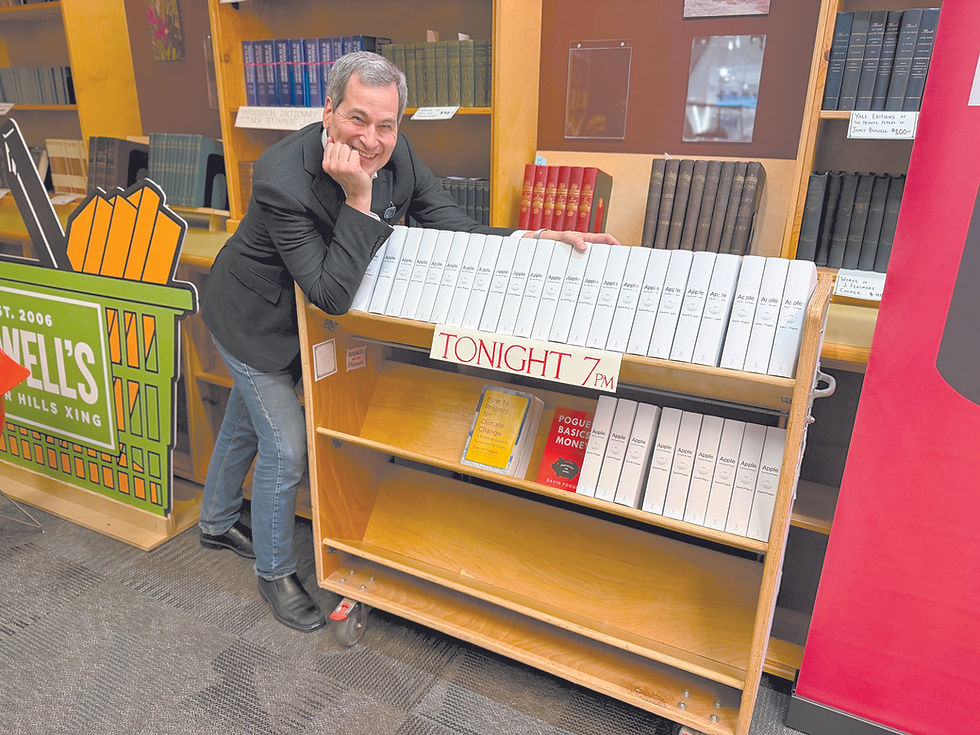
David Pogue of Bedford Hills, a “CBS Sunday Morning” correspondent, best-selling author and Recorder contributor, recently wrapped up a nationwide tour promoting his latest book, “Apple: The First 50 Years.” We asked him to share his experience.
We, the world’s authors, crank out four million new books a year. (3.5 million of them are self-published.) The vast majority vanish without a trace; four out of five don’t even sell 100 copies.
For some people, just saying “I wrote a book” is reward enough. But if you actually want people to buy your book, you need publicity. It doesn’t matter if you’ve written the next “Great Gatsby”; if readers don’t know it exists, you may as well not bother.
How do you publicize a book? You can pursue ads, media appearances, interviews, excerpts, social media — and maybe, just maybe, a book tour.
Probably not, though. Unless you’re a James Patterson or a Danielle Steel, a book tour makes no financial sense. You’ll never sell enough books to cover the travel and promotion costs. (The author typically gets 15% of a book’s cover price. If your book costs $35, that’s $5.25 a book. You do the math.)
Occasionally, though, a publisher might spring for an author tour anyway — not to make money, but to maintain bookstore relationships, keep the author happy, and maybe generate some local media coverage.
My own new book is “Apple: The First 50 Years.” It’s 600 pages long, with 350 color photos. My hope was that a book full of colorful personalities, busted myths, and insider stories might appeal to the tribe of 2 billion Apple fans.
Just this once, the book gods smiled: Simon & Schuster offered to fund a tour of 12 cities, and my wife Nicki offered to join me. For me, it promised to be a once-in-a-lifetime thrill — and so, as a public service, I took notes.
Silicon Valley
The Computer History Museum, in Mountain View, Calif., invited me to kick off the tour by hosting a 50th anniversary reunion panel of prominent characters from Apple’s past.
The museum is right in Apple’s backyard, so I anticipated a decent turnout. And yeah, it was pretty decent: The tickets sold out in 15 minutes.
The night of the show — March 11 — was full of laughter, tears, and PTSD. Many in the audience had suffered through the mid-’90s, when Apple came within weeks of bankruptcy — and then exulted as Steve Jobs, returning to Apple after 11 years away, turned the company around in a single year.
The museum hosted a book signing after the show. The staff asked each person in line to write their name on a Post-it note, ostensibly so that I’d have the right spelling. For me, though, there was a secondary value to the Post-its: They helped me avoid humiliation when someone in line turned out to be an old acquaintance whose name I should have remembered.
Two days later, I arrived in nearby Menlo Park for my first bookstore appearance, at Kepler’s Books. Before the doors had even opened, a line of 200 iZealots stretched down the street. Clearly, I was some kind of superstar.
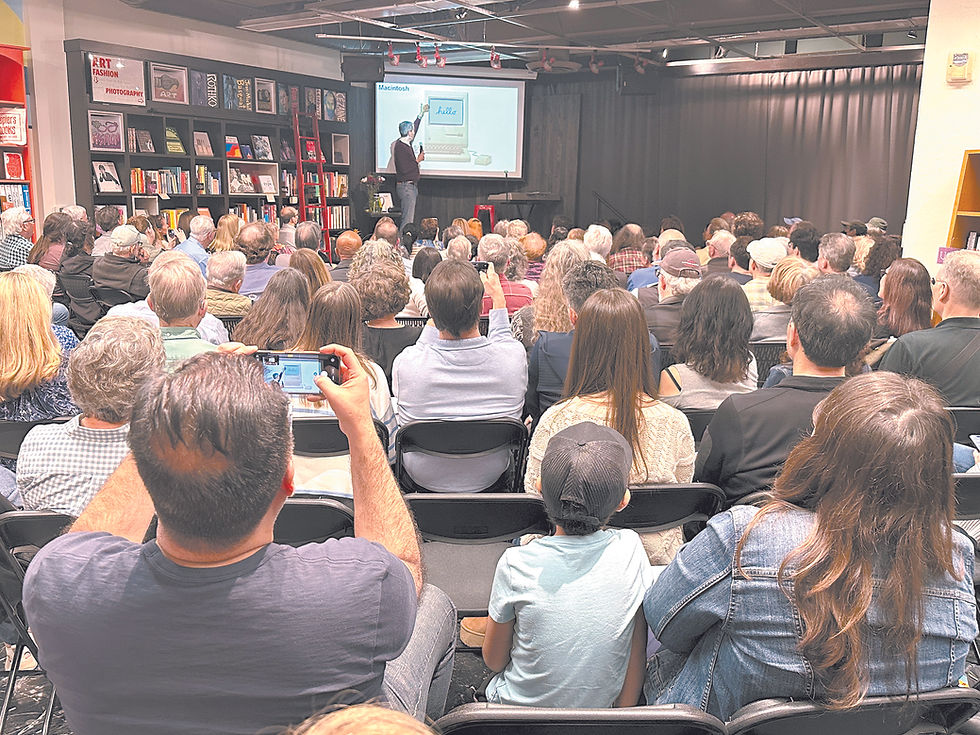
I’d put together an hour-long slideshow, filled with stories, photos, and videos — a ride through the highs and lows of Apple’s first 50 years. To punch up the entertainment value, I sang a few song parodies at the piano (I’m a former Broadway guy), like the immortal “Don’t Cry For Me, Cupertino.”
Kepler’s is only 30 minutes from Apple’s campus, so a lot of current and former Apple folks showed up. Some had worked on some of Apple’s greatest successes (the PowerBook laptop, CarPlay, iPhone) and failures (Apple III, the Apple car). It was weird and wonderful to meet, in person, characters I’d only written about.
Portland, Oregon
Powell’s Books may be the most famous bookstore in America. Its vast, 68,000-square-foot headquarters has become a cultural destination. Here, people spend hours exploring the 1.5 million new, used, and rare books. If you’re invited to appear at Powell’s main store, you’re a big-deal author.
I, alas, was not. My talk had been scheduled for a small Powell’s satellite store in Beaverton, Ore.
Worse, it was on Oscar Sunday. I had to compete with all of Hollywood.
Twenty-four people showed up. God bless ‘em.
Clearly, not all my book stops were going to be Beatles concerts. My ego had just been told to sit down and shut up.
Austin, Texas
I’d always assumed that a book tour meant bookstore visits. But in practice, much of it takes place at town halls, speaker series, and festivals.
In Austin, there’s no bigger festival than South by Southwest (SXSW), a two-week carnival of music, movies, and technology. The organizers offered me a featured-session slot — provided that it take the form of an interview with a key Apple player.
Incredibly, Apple agreed to loan me Phil Schiller, who’s been at Apple for 38 of its 50 years. (I say “incredibly” because Apple executives almost never speak at conferences, let alone to help promote someone’s book.)
As Jobs’s head of marketing, Schiller had been involved with the iMac, iPod, iPhone, iPad, Apple Watch, and AirPods. As a storyteller, he absolutely crushed it. He told one terrific tale after another. Who knew that during a keynote rehearsal, Jobs once mooned Al Gore?
Not many people bought books at SXSW — idiotically, the organizers scheduled the signing four hours before the presentation — but wow, was it fun.
New York City
The Cooper Union is a small private college in Manhattan’s East Village, founded in 1859 with the goal of remaining “open and free to all.”
My presentation, a conversation about Apple’s past and future with reporters Joanna Stern (the Wall Street Journal) and Lauren Goode (Wired), would be held in the original 1859 auditorium. Over the years, I’ve given many a talk behind the chest-high podium known as a Lincoln lectern. But on this night, I stood at a lectern once used by Lincoln himself!
The 92nd Street Y prefers its book talks to involve a journalist interviewing the author. My interlocutor was my friend and “CBS Sunday Morning” colleague Lee Cowan, who’d flown in for the occasion.
Happily, the Y folks managed to round up a piano for the event. (It was not, I learned, a common request for author talks.)
The Villages, Florida
In the pre-internet days, if you had an Apple computer, there was only one place to go for advice, troubleshooting, and software: user groups. Every city had one.
The internet killed off most of them, but about 50 user groups survive. It occurred to me — OK, fine, it occurred to Nicki — that they’d make perfect audiences for a book about Apple. Thus was born David Pogue’s virtual book tour.
I wound up giving Zoom presentations for 11 user groups in eight states. These may have been remote talks, but I gave them the full treatment, including the songs. Nicki, downstairs, later told me how weird it was to hear me singing at the top of my lungs from inside my little home office.
But not as weird as our visit to The Villages, the surreal, master-planned senior community in Florida. There are 56 golf courses and 100 rec centers, whose architecture runs along themes like Spanish Colonial, New England seaside, and Old West. The 150,000 residents drive their customized golf carts to Villages-owned restaurants, malls, and theaters.
Whatever your thing, The Villages has a club for it: pickleball, woodworking, line dancing, archery, fishing, and 4,000 more. And, of course, there’s an Apple club — with over 900 members, it’s one of the world’s biggest.
At the rec center, my laptop had to sit directly next to the projector in the center of the room, 30 feet from the podium. In other words, I couldn’t advance my slides myself.
Fortunately, Nicki volunteered to work the slides. I didn’t even have to cue her; by this point, she’d seen my presentation 13 times.
Atlanta, Georgia
You might not be surprised to learn that someone has built an Apple museum. You might, however, be surprised to learn that it’s in a former shopping mall an hour outside of Atlanta.
A millionaire real estate developer named Lonnie Mimms has spent 40 years buying computer artifacts. His Apple exhibits alone fill nine enormous galleries. Before my talk, I sat down at an original, working Apple II to play some Oregon Trail.
The event was held in a movie theater, the only surviving piece of the original shopping mall. Therefore, the audience watched from padded reclining seats with cup holders, and my slides appeared on a screen the size of a cargo ship.

Bedford
The Bedford Playhouse hosted one of the final stops of the tour; Bedford Books ran the book signing. Every city had had its charms, but this was something magical. This time, I was talking to the people I know, people I love, in the town where I live.
And now, at last, the tour is over. It’s impossible to measure the results, because it was only one piece of the publicity puzzle. But in the end, “Apple: The First 50 Years” spent five weeks on the New York Times bestseller list.
Was that because I’d written a masterpiece? Or was it because, as the lucky ambassador for the Apple tribe, I’d gotten to ride their wave of love for an iconic company?
Doesn’t matter. In the end, the real reward was meeting about 3,000 readers face to face: shaking their hands, hearing their stories, accepting their extraordinary kindness. One fan had traveled all the way from Tokyo. Another gave me a 3-D printed keychain whose fob was a tiny, flawless replica of the book’s cover. And a former Apple product manager loaned me his rare, transparent prototype of the 1991 PowerBook, Apple’s first successful laptop, to exhibit on the book tour.
I’m so fortunate and so grateful: that people still care about books, that my publisher was willing to fund a book tour, and that when the tour ended, I could spend the summer recovering in the loveliest town imaginable.
I’m thinking maybe I’ll read a book.