

.png)


![CA-Recorder-Mobile-CR-2025[54].jpg](https://static.wixstatic.com/media/09587f_b989949ec9bc46d8b6ea89ecc2418a8a~mv2.jpg/v1/fill/w_370,h_150,al_c,q_80,enc_avif,quality_auto/CA-Recorder-Mobile-CR-2025%5B54%5D.jpg)


What’s in Season: Ginger from Turtle Rock Farm in Bedford
Updated: Feb 24
By AMY SOWDER
Knobby, twisted and an unimpressive shade of beige, ginger is a prime example of why you shouldn’t judge a book by its cover.
Underneath that thin, bark-like exterior lies a hidden power to punch up the flavor of your food like no other.
And Brian Mansour grows it right here in Bedford.
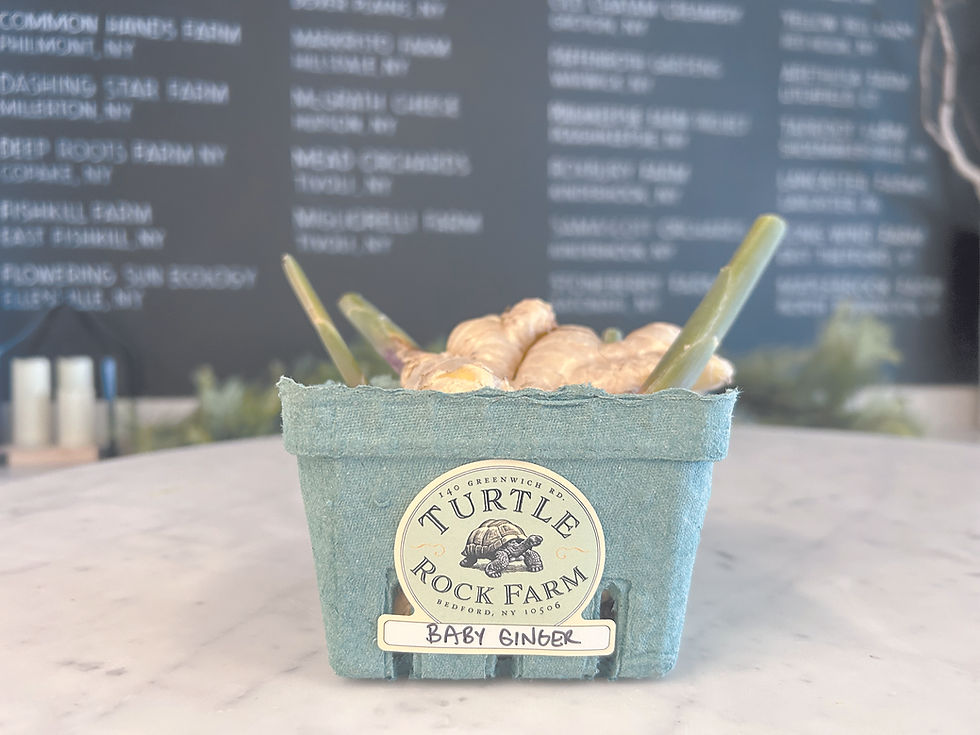
“With baby ginger, it’s milder, super tender, not fibrous. The more mature the ginger, the more intense the flavor is. The late teen years is what the ginger is now,” said Mansour, manager of Turtle Rock Farm. “Our indoor methods and grow lights extend our season.”
Mansour first imports the seed — which is just a knob of ginger grown for seeding purposes — from Hawaiian Clean Seed, also called Biker Dude Puna Organics. Then he germinates the seed for four to six weeks into a sprout that’s 6 to 8 inches tall.
“Meanwhile, we’re out prepping the soil in the greenhouse. We’re a little bit crazy about the quality of the soil, because good soil means good crops and generally means more nutritious stuff too,” Mansour said.
Turtle Rock Farm uses organic amendments and no heavy fertilizers. They send out soil samples to a lab before the ginger goes in to see what the soil is missing.
“It’s a little more intense than normal. I have a science background, and I don’t like to leave as much to chance if I can help it,” said Mansour, who studied regenerative agriculture while earning his science degree at University of Rhode Island.
Mansour generally transplants ginger into his greenhouse’s raised nitrogen-rich soil beds in May to start harvesting in September. Keeping the soil moist with drip irrigation, Mansour usually harvests ginger through January.
But this year, the 2025 harvest should continue halfway into March.
“We got the seed in [soil] really late, in May,” Mansour said.
Mansour left The Farm at Cabbage Hill in Mount Kisco to manage Turtle Rock Farm from the ground up, an opportunity he relished. “I wanted to be part of the start of a farm,” Mansour said.
Founded in 2023, Turtle Rock Farm has a 4,000-square-foot greenhouse and a little less than an acre for outdoor field growing. The farm is in the early stages of selling its produce, including its baby ginger, at Mast Market and Truck restaurant in Bedford and at Bedford Farms market. The goal is to start selling at farmers markets by 2027.
Besides ginger, he’s growing leafy greens, peppers, garlic, flowers, tomatoes, turmeric, eggplant and snack-size cucumbers. Soon, the farm will launch its website, turtlerock.org.
“We’re not certified organic, but everything we do is with organic practices,” Mansour said.
Ginger is a food not commonly associated with Hudson Valley agriculture. But greenhouses and hoop houses change all that.
Referred to as a root, ginger is actually an underground stem called a rhizome that grows horizontally underground. The ginger rhizome contains 1% to 3% essential oils. The compound “gingerol” gives it that pungent heat. Dried ginger is generally less spicy than fresh ginger.
Ginger is more of a spice than a vegetable. Its flavor profile depends on the variety of ginger and when it’s harvested, often characterized by notes of citrus, mustiness, soap, spicy heat and a little bitterness.
When combined with green onion and garlic, ginger is considered part of the “holy trinity” of Chinese cooking.
For centuries, ginger has been part of healing strategies in Asia, India, Europe and the Middle East. In addition to medicinal uses, ginger is one of the most versatile ingredients, despite its intensity. Try it fresh, dried, pickled, preserved, crystallized, candied and powdered or ground. Ginger is great in cocktails, teas, smoothies, as well as savory and sweet dishes, from curries, soups and stir-fries to jams, cookies and cakes.
Anyone can grow ginger in a pot at home, he said.
“You keep harvesting until the plant is gone,” Mansour said. “At home you can harvest one slice at a time. If you have friends over and want to make a drink with ginger, you can go to your patio and slice it off. It’s great in Moscow Mules.”
But whether you buy it or grow it, the best way to store ginger is to keep it dry, let cool and place it on paper towels in the fridge’s crisper drawer. For long-term storage, put ginger on paper towels in a plastic bag in the fridge. In winter, ginger can sit out on the kitchen counter at the window sill. You can freeze ginger in a freezer bag, but chill it gradually, in the fridge first, then freezer, so condensation doesn’t turn to ice.
For more information, visit turtlerockfarmny.org.
Note from the writer (a big fan of fresh ginger): Try peeling your fresh ginger with a regular table spoon, rather than a peeler or knife. The spoon removes only the thin skin, minimizing waste, but it’s also a more efficient and safer way to navigate ginger’s knobs and curves.


