

.png)


![CA-Recorder-Mobile-CR-2025[54].jpg](https://static.wixstatic.com/media/09587f_b989949ec9bc46d8b6ea89ecc2418a8a~mv2.jpg/v1/fill/w_370,h_150,al_c,q_80,enc_avif,quality_auto/CA-Recorder-Mobile-CR-2025%5B54%5D.jpg)


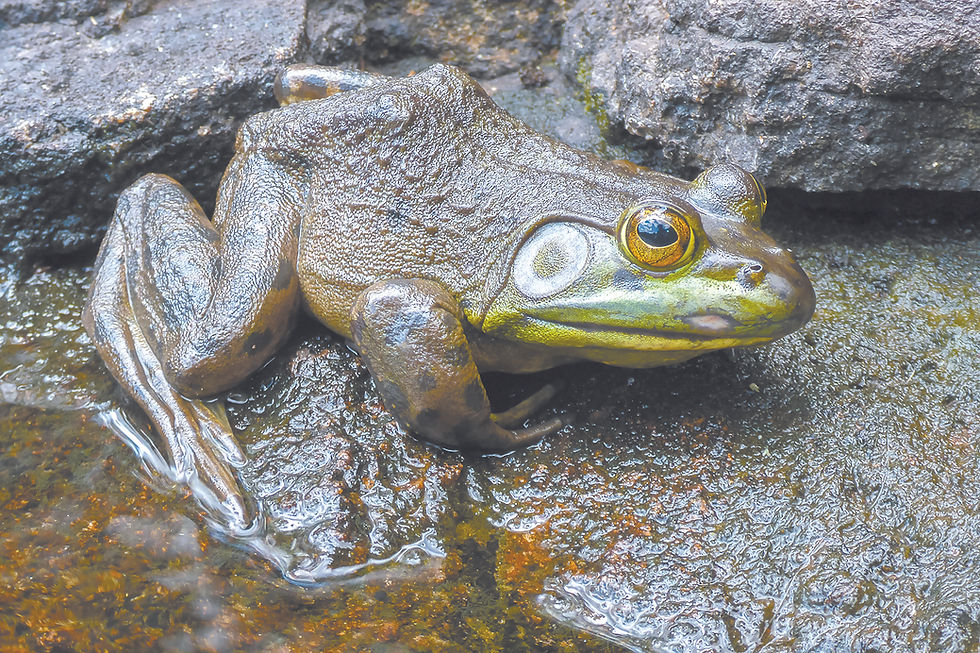
The bullfrog's eternal question: 'What's for dinner? I'm not picky'
- 6 hours ago
- 3 min read
By ED KANZE
Is there something living and moving and small enough to cram into its mouth that a bullfrog won’t eat? I suppose there must be. I’m not sure I know what it is.
Bullfrogs do not, as far as I know, eat dogs and cats, although I’ve seen miniature dogs so tiny they might attract a bullfrog’s interest. Bullfrogs are known to grab and swallow small birds feeding along the water’s edge. They sometimes devour mice and voles, and given their proximity, I bet they gulp the occasional water shrew, too. Bullfrogs eat snakes, and they eat other bullfrogs, green frogs, various tadpoles, small turtles, ducklings, and the largest of dragonflies.
A massive amphibian that can grow to eight inches or occasionally more in length, the bullfrog is native to eastern North America. Because its legs are fleshy, frogs-legs farmers introduced the bullfrog widely in the western states and to various locales in Europe, Asia, and South America. It’s hard to keep these voracious predators captive, so in places where they’ve been held captive, bullfrogs have often escaped and wreaked havoc on the local wildlife.
Once I was guiding a mother and her daughter on a nature hike in the Adirondacks. We were sitting on a sun-warmed rock, having lunch, when I noticed a big bullfrog in the water only inches from the mother’s foot. I was in naturalist mode, so I delivered a brief account of the bullfrog’s famously ambitious appetite. I also mentioned that the frogs see movement far better than they perceive detail.
The mother found this all amusing. She wanted to know if she wiggled the brightly painted big toe of her right foot, which was within leaping distance, if the frog might try to seize and swallow it. I told her I had no idea, but if she wouldn’t mind a bullfrog assaulting her toe, she could conduct an experiment and see what happened. Mom was game. She began wiggling the digit. Within seconds the big frog, which might have weighed a pound, held her toe deep inside its mouth. The woman shrieked, half in laughter, half in discomfort, while the frog, realizing it had taken on a losing proposition, let go.
I hadn’t believed the frog would go for her toe, so in fact, I’d missed the whole thing. My companions were deeply disappointed. They wanted me to see for myself. The frog had retreated to the same patch of water. Again the toe wiggled. Again the frog flew through the air and clamped down on the toe. We all laughed — all of us except the bullfrog.
Once my friend Ted Gilman and I were leading a night walk at the Audubon Center in Greenwich, Conn. We were almost back to the building when we came to a pond. In it, a massive bullfrog held a nearly as big green frog by the tip of the snout. Our companions, overnight guests at an ecology camp, wanted to know if the bullfrog could swallow the green frog. It didn’t look possible, but the walk was essentially over, and these people were adults. Ted and I, who had reached the end of a long work day, told them they could stay and find out. By the time Ted and I left, one front leg had disappeared into the bullfrog’s maw, but three remained to be swallowed.
It was near 11 p.m., when I realized the walkers had not returned. I headed down to the pond. As I grew near, I could hear voices chanting, “Go, go, go, go.” The bullfrog now looked like a balloon ready to burst. The green frog was almost entirely inside its mouth. Only two webbed feet stuck out, still twitching. We all watched as, increment by increment, the last parts of the feet vanished. When only a single toe projected, the bullfrog swam off to the middle of the pond. It remained there much of the next day, digesting, slowly, I imagine, and perhaps regretting the enormity of its meal.


